Volunteering

Tuesday, March 27, 2012

 Meet one of our rabbits!  We have two does (females), a mother and her daughter (this one here).
 This relic is our former shed, chicken coop AND rabbit hutch!  (I would go on and include a picture of our new ones (each is its own entity now) if my computer/camera connection would work more than one time ever.)
We took cuttings of raspberries and gooseberries and planted them in the ground.  Since they have no roots we have to make sure that they get plenty of water and not too much sun.  Once the roots develop in the individual cuttings we will relocate them to sunnier areas in order to increase productivity.  This method of planting is also known as propagation.
Some perennial flowers such as these daffodils are coming up and will serve as an early pollen source for bees that will later pollenate our flowers and allow them to turn into fruit, such as with the raspberries and gooseberries.
We did not have a market for all of our leeks last year, so some were composted.  This one never got deep into the compost pile, so it never got hot enough for the bacteria to digest and disintegrate it, so we replanted it, mostly just for kicks!
Taking advantage of the warm weather last week, we dried our laundry outside.
Andrew Lyons and Shane present to the EcoHouse sustainable agriculture class on the importance of bats in ecosystems and how to improve habitat for them.  Bats commonly predate upon pests of crops and in some cases even serve as pollinators.  They made and displayed a bat house which we will later post near our farm to attract bat colonies!  They also remarked that bats have an undeserved bad reputation for the few and far between cases where they bother people or spread rabies.
Andrew Brown gave his presentation on integrated pest management. He noted that having a diverse crop tends to mitigate pest outbreaks.  Biological pest control is the occurrence of "beneficial" organisms preying upon pests.  For example, some wasps consume caterpillars that eat our plants' leaves!  Just don't bother them and they won't sting you.
... And here we are having our weekly Sunday dinner meeting.  After enjoying our food and celebrating each other's company, we get into business and organize ourselves so we can sustain the farm's productivity and our livelihood.  Special credit to Julia for being our guiding farm manager.  Well, that's all for now.  Signing off -- Trevor

Friday, March 16, 2012

Fedco Bulk Order: March 13th

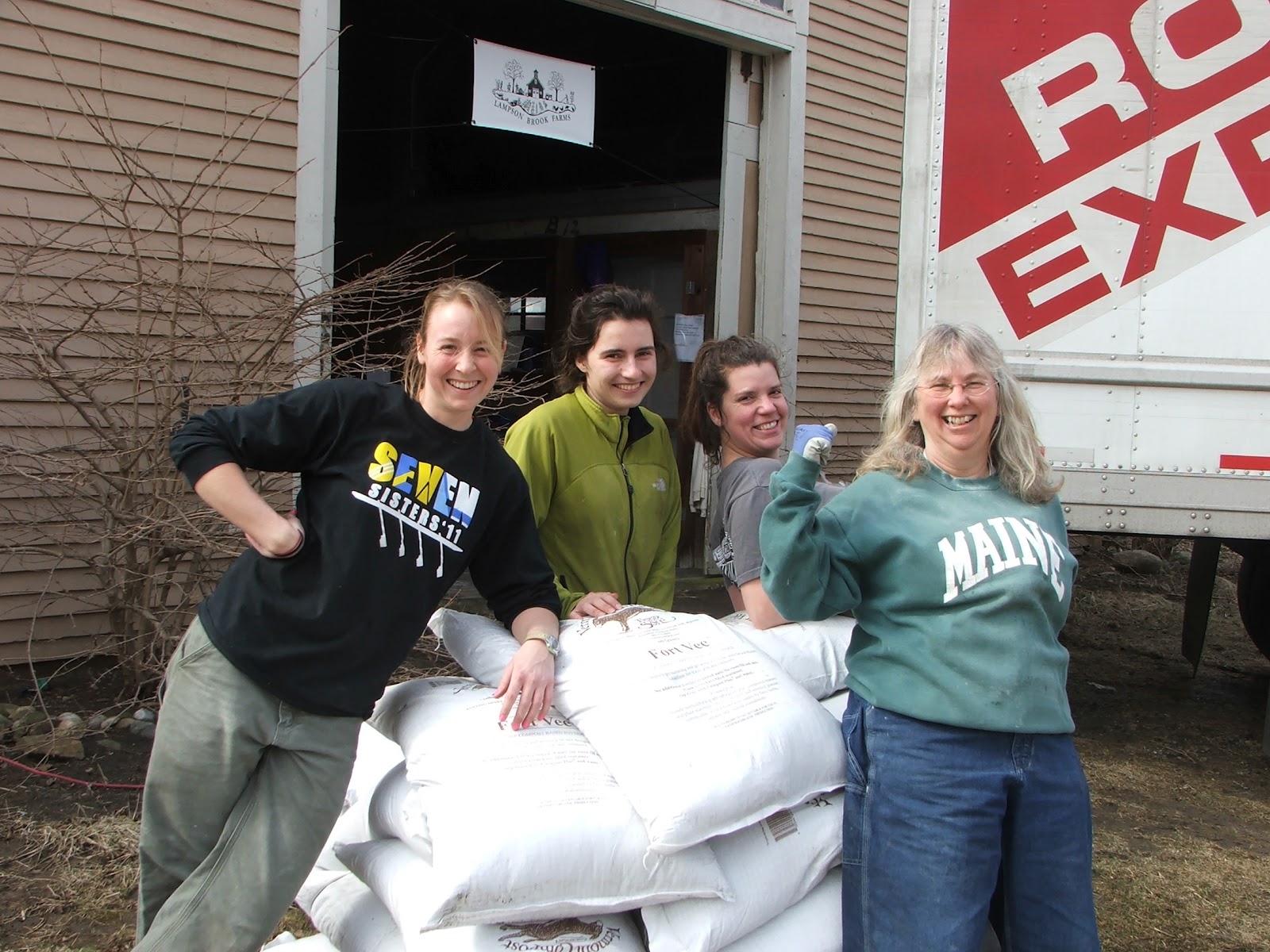
We spent the better part of the afternoon helping to unload and organize Fedco bulk orders in Belchertown, MA.  In exchange for the hours we worked helping to unload pallets of soil amendments, potting soil, garden supplies, and cover crop seeds we got to take home the Fedco bulk order we filled out in January!!  Under the guidance of Cathleen O'Keefe, bulk order coordinator for NOFA Massachusetts, a productive day was shared by all of us as we managed to unload all the Fedco supplies and even put together individual orders to make for a more organized pick up day.  All of the work was done in 68 degree weather. Mind you I am talking about March 13th in Massachusetts…….. Thanks global warming:/

Playing the waiting game....

A pallet arrives!

And another.........

....Ooo look at that! Another pallet

.............And one more!


Looks of sheer determination

Look of sheer...... ummm hmmm

Time for a respite....

......and a photo shoot! Cheers to a job well done by everybody!

-Tanner

Sunday, March 4, 2012

Recent News on the Farm~

1. Overwintering Crops- Towards the end of the growing season, we decided to plant some things to have an early crop come springtime.  Now that spring has (almost) sprung, our winter greens are looking pretty good!  We planted a mesclun mix, spinach and Asian Greens.  Unfortunately, the Asian greens did not fare too well...BUT, our spinach and mesclun look great!  Once the weather gets a bit warmer and the days a bit longer, we are going to have a nice early picking of greens!

 Mesclun Mix is coming up strong!
Spinach!

2. Invasive Control- In these winter days when there is not an excessive amount of work to do outside on the farm, we have decided to start taking control of the invasive problem nearby.  Invasive species can cause a whole mess of problems from taking over native vegetation, changing soil characteristics and local ecosystems to even aiding in harboring diseases!  That said, along our fences and throughout the surrounding are laden with invasive plants.  The prevalent species include Autumn Olive (Elaeagnus umbellata), Multiflora Rose (Rosa multiflora), and Japanese Barberry (Berberis thunbergii).  We have recently received two good pairs of loppers and several smaller hand clippers.  Thus, the invasives are slowly getting knocked down, one by one!
 Multiflora rose along our fence.....goodbye!

Japanese Barberry...may be a nice color in the fall, but it's also been linked with an increasing occurrence of Lyme disease.  Here's a link to a news article that talks about the research done by the CT Agricultural Experiment Station 
L_IMG_fig3.jpg
Autumn Olive...another CT invasive.

3. NOFA Conference- As Laura mentioned in the previous post, we at the farm just participated in the 2012 Winter NOFA Conference held at Manchester Community College.  Although a long and exhausting day, we sure did learn a lot, eat great food, and met some really inspiring people!  First, there was an awesome keynote!  Jeffrey Smith, a bestselling author and leading spokesperson on the health dangers of GMOs touched on the politics of Genetically Modified Foods and where we are in the United States with addressing this hot topic.  Smith talked about many different stories from around the world relating to the risks of consuming GMOs, and why in other countries, these crops are strictly banned.  Between the organic community/environmental advocates, politicians and the Biotech industry, this is a highly debated topic these days.  Without a doubt, GM crops do have many benefits like being disease resistant, especially resilient, and being able to grow outside of desirable environments, for example.  There is great potential to help millions of people gain access to food because of a crop that has been modified to grow in a not so suitable climate.  On the other hand, there is no saying whether being able to tweak the genes of plants to solve problems is better than disrupting the natural processes which have evolved over millions of years.  Consequently, the debate continues.
Jeffrey Smiths first book, a best seller on GMOs

Right now however, Connecticut is on the lines of passing a bill that would label products containing GM crops.  Many feel that we as consumers have a right to know what is in our food (I can't argue with that!).  If this topic is something you feel strongly about, now is the time to contact your representative and tell them how you feel about Genetically Modified Crops.  If the proposed bill does end up being passed, CT will be the first state to have a labeling law of this nature!

Back to the conference:  Each of us attended really great workshops relating to a whole variety of topics.  Personally, I went to three excellent workshops and met some great farmers from around the state.  I sat in on a talk/demonstration by Paul Trubey, owner of Beltane Farm in Lebanon, CT.  I learned about raising dairy goats and making cheese (very cool!).  The second workshop was called 'Mushroom Growing on a Small Scale' with Jim Peppin and Carol Brzozowy, two mushroom farmers out of Lebanon, CT (they mainly do shiitake and oyster mushrooms!).  Lastly, Brianne Casadei of Terra Firma Farm talked about raising pasture laying hens (her farm raises thousands of chickens for both meat and eggs).  All three of these farms are open to the public for educational purposes and hopefully (well I am hoping) to do some farm visits in the near future!  More detailed descriptions and pictures to go along with the workshops are coming.  Stay tuned!

All in all, the conference was a huge success, and we will all be taking what we learned there into future endeavors on the farm!
  
That's all for now folks!
-Lyons

Sunday, February 26, 2012

Cooperative Coop Design

As you may or may not know, Spring Valley Student Farm currently has 7 resident chickens living happily in their little coop out in the garden. Recently, though we have begun to feel that 7 chickens simply isn't enough so we have decided to get more of these fine feathered fowl.These additional birds will be kept up at the second house which now means, eggs for everyone!
In order for us to get more chickens however, there has to be a place for them to live. So a few of us farmers took the liberty of drawing up some blueprints for our new chicken coop.
The coop can either be built from scratch or modified from our existing rabbit hutch.

The design includes 6 laying boxes (3 on each side) as well as an enclosed area beneath the coop where the chickens can scratch about during the day. One feature that we thought would be very important is the wide hatch located on the front of the coop. This would make cleaning the coop and feeding and watering the hens much easier.
And hopefully the chickens will love it too.

-Laura

Upcoming NOFA Conference

Howdy All!
It's hard to believe but February is almost over and March is just around the corner. We've been pretty busy at the farm getting things ready for the new planting season but we also have an exciting trip planned that is coming up soon!

March 3rd (next weekend!) we SVF farmers will be attending the 30th Annual CT Northeast Organic Farming Association (NOFA) Conference.
http://www.ctnofa.org/events/CAOC/2012/2012_Winter_Conference.html
The conference will be held at the Manchester Community College and will have all sorts of awesome workshops on subjects from permaculture, to bee keeping, to soil management, growing mushrooms, raising pasture fed hens, and even how to brew you own organic beer (Not that we at SVF have any need for that sort of knowledge)! All in all it should prove to be an informative and interesting Saturday and hopefully we will be able to apply some of what we learn at Spring Valley.

-Laura

Sunday, February 12, 2012

Getting Down to Business

The semester is well underway and Spring Valley Farm is making big plans for the future.  Each of us is now busy writing up pieces of our new Constitution (Our Purpose, Responsibilities, Conflict Resolutions, Application/Admissions, Commitment to EcoHouse and Uconn, etc).  Doing so will likely eliminate the need for an R.A. next year, and we can thus add more farmers to our community with the newly available room (woo!).
We've mapped out which crops are going into which plot and now all that's left to do is to get all our seeds and plant! (when it warms up of course).  We're also ready to install a brand new Hoop House to grow some of our crops earlier.  Birch Cottage has also gotten approval to get their own chickens and coop; we're planning on making quite a chicken mansion.  With the addition of our huge newly plowed back plot and the plot behind Birch Cottage, we're going to have an intense growing season!
The party we had last week was a great success and we had a surprisingly impressive turnout!  We're planning on regularly hosting more of these parties from now on (two or more each semester).  Our next get-together is tentatively set for March 17th; hopefully this time the weather will permit us to do some fun outdoor activities (contra dancing anyone?) and we'll be able to make it more of a potluck with the addition of more homemade food.                                          
                                       Veggies, Sweet Potato Fries, Garlic Bread, and Cookies, Yum!


Some wholesome after-dinner games: Bananagrams and Spoons! What better way to spend a cold Saturday Night?

-Paul

Sunday, February 5, 2012

We the People....

We the farmers here at Spring Valley Student Farm (student title was inserted because apparently there exists a Spring Valley Farm in CT already (Hi other SVF)), are attending to business with farm protocol (seed ordering and what not) but also are looking to set in place a constitution in order to sustain our community and help it develop. Upon meeting with Steve Kremer, director of ResLife, the other day and eating some delicious pizza, we decided to establish a plan and some type of documentation to maintain the community. Incorporating a constitution will also allow us to really determine what our mission is here and how we will go about achieving it. The meeting also laid out a loose plan for what's going to happen in the summer, basically going over the fact that three main farmers will be given positions to do a majority of the tasks and others who live there can help out as sharecroppers part time. Overall it was a rather productive meeting and the upcoming weeks will be very promising in terms of progress for SVSF.
Steve Kremer
The constitution that is going to be worked on by the community's members will delve into all aspects of a community including attending to tasks on the farm, resolving conflicts, and even making amendments and allowing for the system to be dynamic enough to change for the better if needed.
On a more fun note, we held a dinner party on Saturday night where many Ecohousers and some non-Ecohousers were in attendance. Games and festivities were conducted and it was wonderful.

-Chris

Sunday, January 29, 2012

Spring is coming!

Hello folks!

It's a new year and we're undergoing some big new changes here at Spring Valley Student Farm. We had a very successful 2011 growing season. From May to November, we delivered over 3,500lbs of produce to UConn Dining Services! Wow!

Here's a shot of the backyard. To the left you
can see our new work-shed and washing station.
To the right you can see our rabbit hutch.
Dispersed around the yard are scarecrows which we made
with EcoHouse students at our autumn farm party

Earlier this month, we met with some of the chefs from Chuck and Augie's, a restaurant located in the UConn Student Union, in order to plan out what produce we will grow for them this year. C&A's is our primary venue on campus. This coming summer, in addition to South Dining Hall and Putnam, we will also be delivering to Northwest! Then, come Fall 2012, you'll find many SVSF seasonal items at Whitney Dining Hall in East Campus.

We are expanding our growing area by approximately 4,000 square feet this coming season, so we've been hard at work picking out seeds and materials from various catalogs as well as planning out our crop rotation schedule.  Some new notable crops will be added to the roster... along with some old favorites.

Here are just a few new & exciting varieties that we are going to be growing:
  • Listada di Gandia - an Italian heirloom eggplant (yum!)
  • Piel de Sapo - a type of muskmelon (the variety name literally means "toad skin" in Spanish!)
  • Rose Finn Apple Fingerlings - an heirloom potato with deep red flesh
  • Indigo Rose - a deep, dark red (almost black) heirloom tomato variety with a  high concentration of anthocyanins. Anthocyanins are plant pigments which have powerful health benefits and anti-oxidant effects!
  • Bucklunch - a type of sugar beet which produces tubers up to 10lbs; they have a very high concentration of sucrose, which we intend to extract and use for our various cooking needs in an effort to become less reliant on refined sugar derived from sugarcane!
We're very excited for the upcoming season. All of the student farmers have been researching various crops and learning about developing rotation schedules to maximize productivity and reduce incidence of pests and diseases. Despite these January days which seem more like early-April, we're not yet ready to get started with planting... but all things in their own time. Time to go hibernate for a bit longer. :)

"Whatchu lookin' at?"


-brown